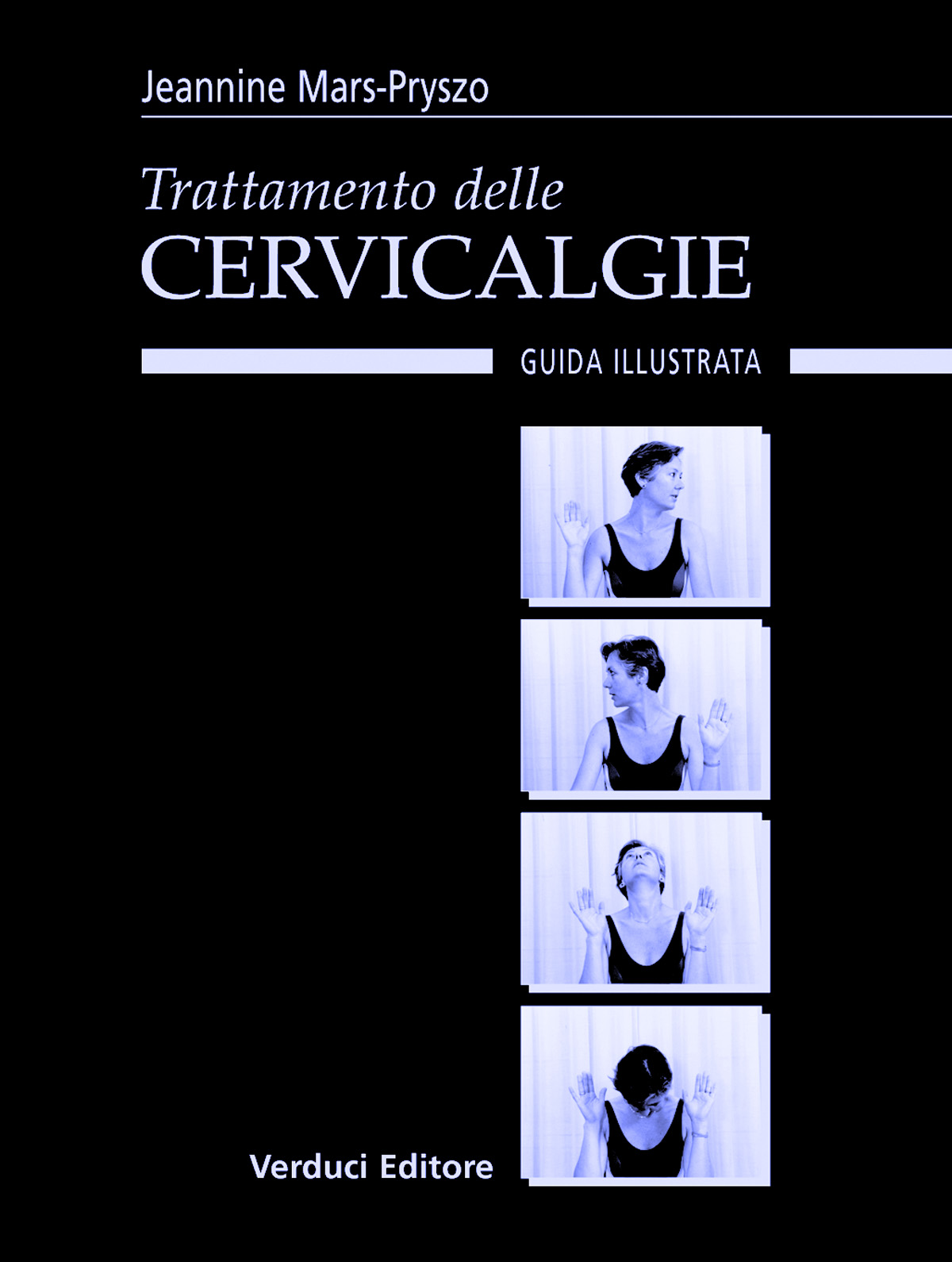
Trattamento delle Cervicalgie
Format 17 × 25 cm, approximately 183 pages, with numerous illustrations.
Common cervicalgia may result from different mechanisms: some primarily justify pharmacological treatments, while others require physiotherapy management through massage therapy and therapeutic exercise. Depending on the clinical presentation, priority may be given to restoring mobility, improving proprioception, strengthening the cervico-dorsal muscles, or reducing muscle tension across the cervico-dorso-scapular region.
Physiotherapists therefore need to master a rich and varied technical repertoire grounded in scientific knowledge of the physiology and pathology of the cervical spine. This practical perspective moves away from “methods” based on quasi-philosophical concepts of the locomotor system extended to the whole organism.
Drawing on extensive hospital-based experience, the author proposes not a single “method”, but a technical set of intelligent exercises presented in a didactic way and designed to be integrated into a cervical spine rehabilitation strategy. Confronted with the challenges of treating cervicalgia, the author recognised the value of relaxation and, through Moshe Feldenkrais’s teaching, identified a movement-, posture- and gesture-based approach capable of inducing relaxation while remaining within clinical practice.
In language that is sometimes simple yet consistently authentic and engaged, the book shares the outcomes of long-standing work with patients and students. Both newly qualified physiotherapists (often lacking practical training) and experienced clinicians will find a high-quality technical resource for addressing cervico-dorso-scapular postural disorders.
Prof. Michel Revel – Department of Rehabilitation, Cochin Hospital, Paris.
Original price was: €26,00.€24,70Current price is: €24,70.
Additional information
| edizione | Gennaio 2001 |
|---|---|
| autori | Mars-Pryszo J. |
| formato | Volume formato 17 x 25 |
| pagine | 183 pagine |
Description
Overview of the treatment
- Indications
- Origins of a new therapeutic exercise perspective
- Developing body awareness through movement
- Discovering the technique and training
- Brief professional background
- Treatment
- General principles of treatment
- Specific features of the treatment
- Analysis of the therapeutic process for active re-harmonisation of muscle tone
- Conducting the treatment
Lessons and complementary therapeutic exercise
Supine position
- Lesson 1: cervical flexion–extension mobility stimulated by antero-posterior pelvic movements
- Lesson 2: cervical approach through internal movements
- Lesson 3: cervical rotation stimulated by antero-posterior rotational movements originating in the pelvis and transmitted through the spine
- Lesson 4: antero-posterior and rotational cervical mobilisation using shoulder movements (“candlestick” movements)
- Lesson 5: micro-mobilisations in flexion–extension with triple flexion of the lower limb
- Lesson 6: active shoulder mobilisation inducing reflex cervical coordination mobility
- Lesson 7: active micro-mobilisation of the head
- Lesson 8: self-assisted mobilisations and further work on reprogramming the oculo-cephalic rotation system
- Lesson 9: cervical stretching through pelvic elevation
- Lesson 10: assisted anterior strengthening and posterior cervical stretching; with head supported, cervical, thoracic and abdominal strengthening
Complementary exercises for the supine position
Side-lying position
- Lesson 1: introduction to passive cervical spine rotation mobilisation
- Lesson 2: cervical approach through internal movements
- Lesson 3: upper-limb movements inducing head mobility, guided by gaze towards the hand
- Lesson 4: more pronounced active–passive cervical mobilisation
- Lesson 5: active head mobility in flexion–extension
- Lesson 6: cervical muscle strengthening with the head supported
Prone position
- Lesson 1: micro-mobilisations of the cervical spine via rocking of flexed lower limbs, then via pelvic rocking
- Lesson 2: crawling/creeping movement
- Lesson 3: cervical postures through hip (coxofemoral) mobility
- Lesson 4: cervico-scapular postures through lower-limb extension–adduction
- Lesson 5: rehabilitation of internal mobility through coordination with foot movements
- Lesson 6: cervical mobilisation via scapular-girdle movements and coordination of internal movements
- Lesson 7: scapular-girdle mobilisation
- Lesson 8: crossed lifts
- Lesson 9: cervical mobilisations with head supported
- Lesson 10: active cervico-dorso-scapular mobilisations
- Lesson 11: cervical and dorso-scapular strengthening
- Lesson 12: cheek sliding; cervical and dorso-scapular strengthening
- Lesson 13: circumduction cervical mobilisations
Complementary exercises for the prone position
Related products
-
 Costanzo D. - Costanzo G.
Protesi, Tutori, Ortesi e Riabilitazione
Original price was: €38,00.€30,00Current price is: €30,00. Buy now -
 Giannicola G. - Salustri M.
Il Gomito – Aspetti Clinici e Riabilitazione
Original price was: €43,00.€40,85Current price is: €40,85. Buy now