Longevità
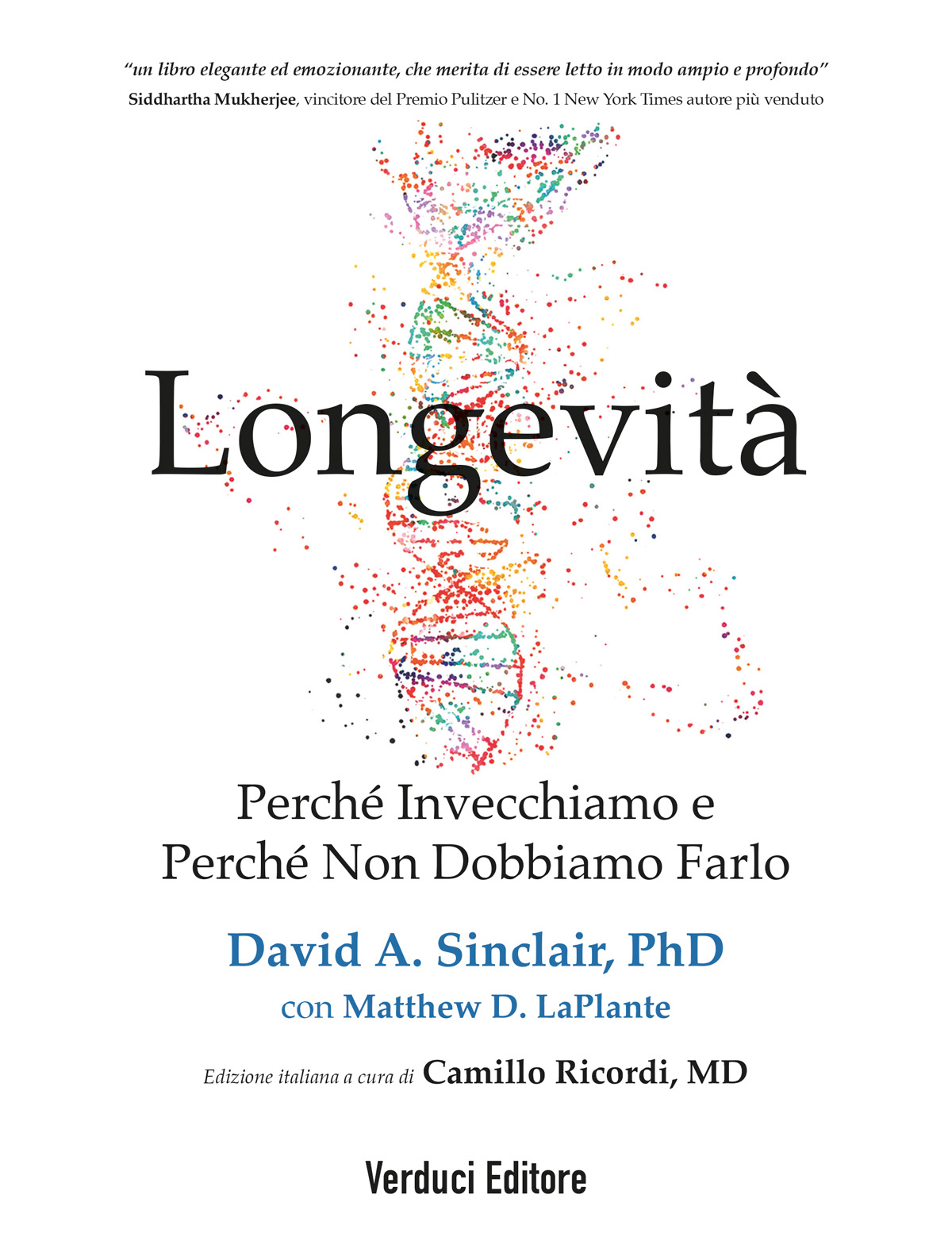
“Longevità” is the Italian edition of “Lifespan”, a masterpiece produced by the irreverent and anti-paradigmatic genius of David Sinclair, a pioneer and international leader in ageing and longevity research.
This work captured my attention from the very first chapter, where Sinclair cites Thomas Kuhn’s book “The Structure of Scientific Revolutions” (La Struttura delle Rivoluzioni Scientifiche), which had fascinated me to the point that it became the subject of my presidential address at the international congress of the Cell Transplant Society. Kuhn explained how scientific progress inevitably leads to new questions, which researchers initially attempt to answer within the boundaries of the current paradigm. This is because the old guard, which among other things controls the allocation of scientific funding, would find it difficult to embrace a revolutionary new hypothesis that challenges the dogma it has established.
Over time, the crisis grows until a “paradigm shift” emerges, which occurs not so much because the old guard becomes convinced by the new evidence, but rather because it dies out and is replaced by a new generation of scientists.
In the days of Galileo and Copernicus, a paradigm shift such as the idea that the Earth revolves around the sun, and not the other way around, could take centuries. Fortunately, timelines are shortening, and I hope that the revolutionary new paradigm introduced by David Sinclair will soon be accepted clearly and unequivocally: ageing is a disease… we age, but we might not have to. A concept very close to my own view of old age, long regarded as an irreversible terminal illness (sexually transmitted), yet one that does not necessarily have to be so, or could at least be converted into a chronic condition with a far more prolonged course.
From the second chapter onward I was truly struck when Sinclair recounts his meeting with Doug Melton at Harvard, another giant and “paradigm shifter” in the field of stem cells. I am honoured to call Doug a friend, colleague and collaborator, with whom we will soon carry out the first transplants of stem cells differentiated into insulin-producing cells for the treatment of diabetes. Doug had certainly recognised the transformative potential of Sinclair’s thinking, awarding him the Helen Hay Whitney Foundation fellowship, which in 1995 enabled him to move to Boston and continue his remarkable career.
My surprises continued as I moved through chapters that will draw you in more and more, up to the end of chapter seven, where Sinclair speaks of Luhan Yang, another friend and collaborator whom I recently brought into the operating theatre in Miami to observe a pancreatic islet transplant. With Luhan, who currently works in China, we remain in contact to discuss how best to genetically edit pigs in order to “humanise” their organs, enabling future transplants as if they were human organs (in the United States more than 11,000 patients die each year due to the lack of organ donors, and in China the problem is far more severe). Luhan was recently named a “Young Global Leader” at the World Economic Forum and one of Forbes Magazine’s “30 under 30”, among the 30 most influential people under 30 in science and healthcare.
I could continue listing shareable elements and anecdotes all the way to the end of this highly engaging book, but that is not why I was asked to contribute this brief introduction to the Italian edition of “Lifespan”.
In this work, Sinclair helps us understand that ageing is not written into the code of creation and that only human curiosity, clarity of mind and anti-paradigmatic intelligence can make us worthy of the gift of life. Sinclair takes us on a journey that begins with the historical milestones of the most critical stages of ageing and longevity research, reaches the present, and then pushes to the frontiers of science, allowing us to discover what only a few years ago would have been considered a heretical hypothesis—science fiction—yet which now could overturn the dogma of the inevitability of ageing.
Sinclair’s discoveries and research into the factors that have made it possible to double life expectancy in experimental models, deciphering the secrets of “immortal jellyfish” and bicentennial whales, and introducing the “Information Theory of Ageing”, explain how ageing is a loss of “youthful information”, in which epigenetic “noise” introduced by risk factors progressively reduces our healthy life expectancy.
It was once said that our genetic endowment determined life expectancy… now it is thought that it may contribute perhaps 15%, while 85% is determined by epigenetic factors. Yet it may be possible to reset the epigenome and slow the ageing clock—or turn it back by decades—thanks to an army of molecules that have been discovered and are under development: polyphenols, sirtuin activators, pterostilbene, polydatin, lactoferrin, fisetin and senolytics, to name just a few. International laboratories are increasingly focused on these topics, because even if not many believe that living to 150 is achievable or desirable, one point we can all agree on is that extending healthy survival—the so-called healthy lifespan or healthspan—is not only desirable and achievable, but represents a moral duty of any modern and responsible society.
The goal of extending healthy life has become more attainable also thanks to the exponential progress of genomics and biomarker platforms such as “InsideTracker”, where the identification of risk factors and individual biological tracking make it possible to define personalised strategies, determining each person’s biological age based on markers that change with age, and also allowing changes over time to be monitored as a result of innovative strategies introduced to rejuvenate or slow ageing.
In the USA, longevity has declined over the past three years, and for the first time children born today may live less than their parents. Ninety per cent of the population over 65 is affected by at least one chronic degenerative disease, with 75% affected by two comorbidities. It is now clear that these comorbidities, together with advanced age, are critical risk factors also for the development of the most severe complications of viral infections, such as Covid-19.
Chronic inflammation induced by diet is emerging as a significant factor that can influence the incidence and progression of many degenerative conditions, including obesity, diabetes, cardiovascular disease, osteo-articular disorders, neurodegenerative diseases, autoimmune diseases and cancer, to name just a few.
In parallel with the evolution of unhealthy Western diets and the progressive lack of protective factors, a common context has developed that predisposes to disease. Greater investment in prevention and in research on the biology of ageing and on extending healthy survival is now an essential necessity—critically important, like global warming and the environmental sustainability of our planet—if we are to hope for a future for our children and grandchildren that is better than our own.
Enjoy the reading!
Camillo Ricordi
Original price was: €16,00.€15,20Current price is: €15,20.
Additional information
| Autori | Sinclair David A. |
|---|---|
| illustrazioni | Delphia Catherine L. |
| formato | 15 x 23 |
| pagine | 448 |
Description
Part I: What We Know (The Past)
- Viva Primordium
- The Mad Pianist
- The Epidemic of Blindness
Part II: What We Are Learning (The Present)
- Longevity Now
- A Less Bitter Pill to Swallow
- Great Leaps Forward
- The Era of Innovation
Part III: Where We Are Heading (The Future)
- The Shape of Things to Come
- A Path Forward
Epilogue
Acknowledgments
Notes
Exploring Sinclair
The Scale of Things
People Mentioned in the Book
Glossary
Index
Related products
-
 WEBB W.R. - BRANT W.E. - MAJOR N.M.
Nozioni Fondamentali di TC-BODY – 5th Edition
Original price was: €95,00.€90,00Current price is: €90,00. Buy now -
 Hofer M.
Manuale di Tomografia Computerizzata Approccio sistematico alla refertazione TC
Original price was: €85,00.€80,50Current price is: €80,50. Buy now -
Sans N. - Lapegue F. - Faruch-Bilfeld M. - Jacob D.
Ecografia dell’Apparato Muscolo-Scheletrico
Original price was: €70,00.€66,50Current price is: €66,50. Buy now