A Cosa Serve la Biochimica
17 x 24 format volume, 269 pages, with numerous images.
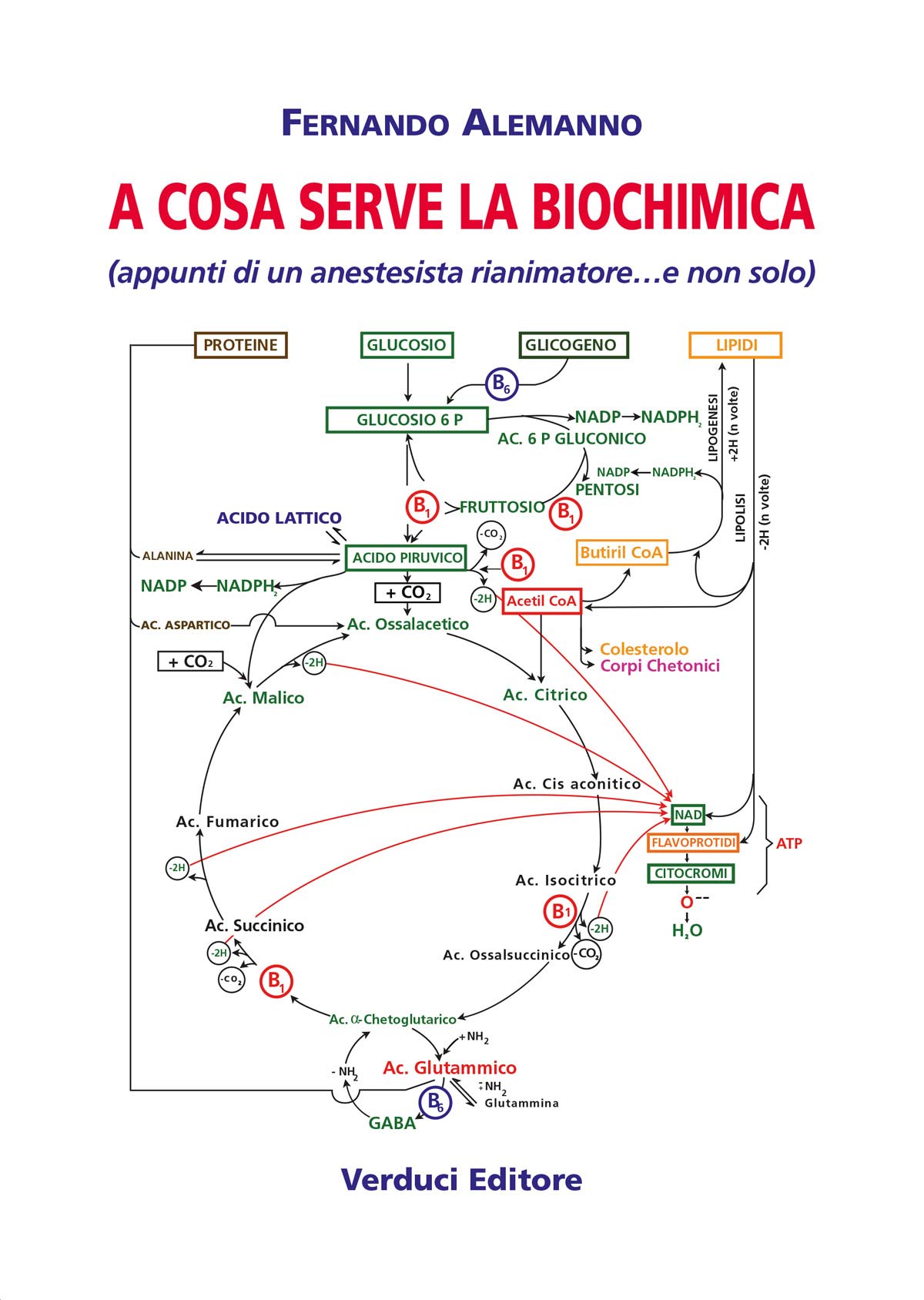
So, what is biochemistry for? It helps us try to understand, at any moment, what we are doing to the patient during anaesthesia or during their stay in intensive care. It helps us understand, to give only a few randomly chosen examples, that if we hyperventilate an anaesthetised patient—or a patient in intensive care—for a prolonged period, keeping PaCO2 below 25 mm Hg, we risk blocking the carboxylation of pyruvic acid into oxaloacetic acid, thereby compromising the Krebs cycle, with a possible drift towards metabolic acidosis—considered not as a compensation for the obvious respiratory alkalosis but as a complication; or that a curare agent, in addition to blocking neuromuscular synapses, may also have (for better or worse) a ganglioplegic effect, because ganglionic synapses are also predominantly nicotinic synapses.
It reminds us that vitamins are not “little toys” we are inclined to underestimate and classify as supplements, but molecules of remarkable potency. Just think of the hydroxylating action of ascorbic acid, which affects collagen synthesis and the conversion of dopamine into noradrenaline; or the multiple actions of vitamin B1, or vitamin B6, which transforms one of the most powerful excitatory mediators (glutamate) into one of the most powerful inhibitory mediators (GABA).
Anaesthetic practice, without deep cultural foundations, can be boring, and the only alternative to boredom may be something unpredictable that happens—something we must be able to face and solve rationally in real time.
Original price was: €40,00.€20,00Current price is: €20,00.
Additional information
| edizione | Ottobre 2016 |
|---|---|
| autori | Alemanno F., Bosco M., Barbati A. |
| formato | Volume formato 17 x 24 |
| pagine | 269 pagine |
Description
- Enzymes and Coenzymes
- Anaerobic glycolysis
- The Krebs cycle
- The collateral glutamate–GABA cycle
- Pentose cycle or direct oxidative pathway
- Neurotransmitters
- The blood–brain barrier
- Shock
- Cerebral oedema
- When the mind does not work properly
- Thiamine
- Normobaric oxygen therapy (NOT)
- Acid–base balance
- Hypotheses on narcosis
- Local anaesthetics
- The big picture
Related products
-
 Neri S. - Pulvirenti D.
La Sindrome Epatorenale
Original price was: €13,00.€12,35Current price is: €12,35. Buy now -
Gasbarrini G. - Cricelli C. - S.I.M.G.
Trattato di Medicina Interna
Original price was: €280,00.€140,00Current price is: €140,00. Buy now