

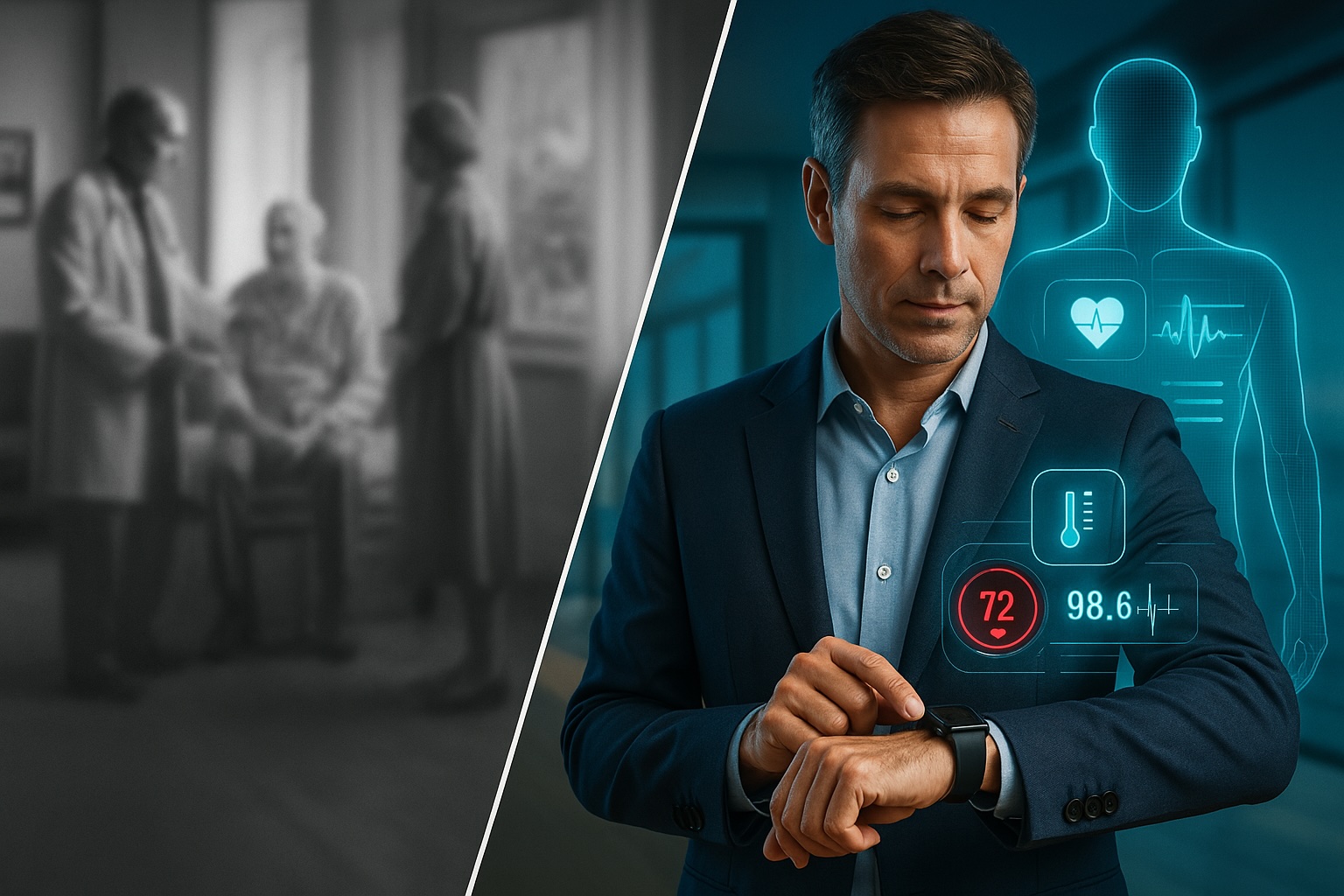
A Sharp Colour Photo vs. a Long Blurry Black-and-White Film: The Silent Revolution of the Digital Twin
Eight years ago, I began researching the Digital Twin for Health. I was not a doctor and, in the medical world, that was enough to be dismissed outright. I was not invited into the room – I had to break in. I had to study more, understand more, work harder. What felt like a disadvantage at the time turned out to be my biggest strength: I was not conditioned to follow a pre-formatted path. I had a completely different lens.
From clinical habits to data-driven thinking
I come from the world of supercomputing, algorithmic modelling and what is now called AI. My mindset is statistical, not clinical. My language is made of graphs, probabilities and data streams – not pain, symptoms or bedside manner. When I look at a patient, I do not see a story of suffering. I see a dynamic system, a pattern waiting to be decoded.
The weak link: anamnesis as “recollection”
And here is where the absurdity starts. In modern medicine, the most important part of diagnosing a sick patient is the anamnesis – a word that, in Greek, literally means “recollection”.
Think about it. We are asking human beings – often scared, sick or confused – to accurately remember events from six months ago. From a mathematical point of view, that is sheer madness. That is not healthcare; that is rolling dice in the dark.
Flipping the script: collecting data before illness
So I flipped the script: what if we collect the data before the illness? That way, when something happens, we already have the full picture. No guessing, no memory games. This turns anamnesis from a retrospective tool into a predictive system.
Simple logic, right? But logic often terrifies systems that thrive on tradition. And the medical world – let us be blunt – is still very much built on tradition.
The Digital Twin does not replace doctors – it empowers them
Doctors often feel threatened by this. They think the Digital Twin is here to replace them. That is not only wrong – it is the opposite of the truth. The Digital Twin frees the doctor from repetitive, low-value tasks. It allows them to be faster, sharper and more accurate. It is an invisible assistant that works 24/7, never sleeps, never forgets.
And here is my “sin”: I am a lazy tech guy. I build systems that let me work less, earn more and help more people. The Digital Twin lets me do exactly that. It reduces effort, increases accuracy and, most importantly, scales care.
Not only does it make the doctor’s life easier – it also restores fairness to the system. The sick patient wants to be healed, ideally for free. But the healthy person has a clear financial interest in staying healthy. They will pay almost anything not to get sick.
From blurry film to sharp colour image
And yet, many in healthcare still refuse to see it. Why cling to a blurry black-and-white film when we now have a crystal-clear image in colour? Why resist a system that works better, faster and more fairly – for everyone?
The Digital Twin is not the future. It is already here. It does not need a passport. It only needs brave minds and long-term vision.
Sergio d’Arpa