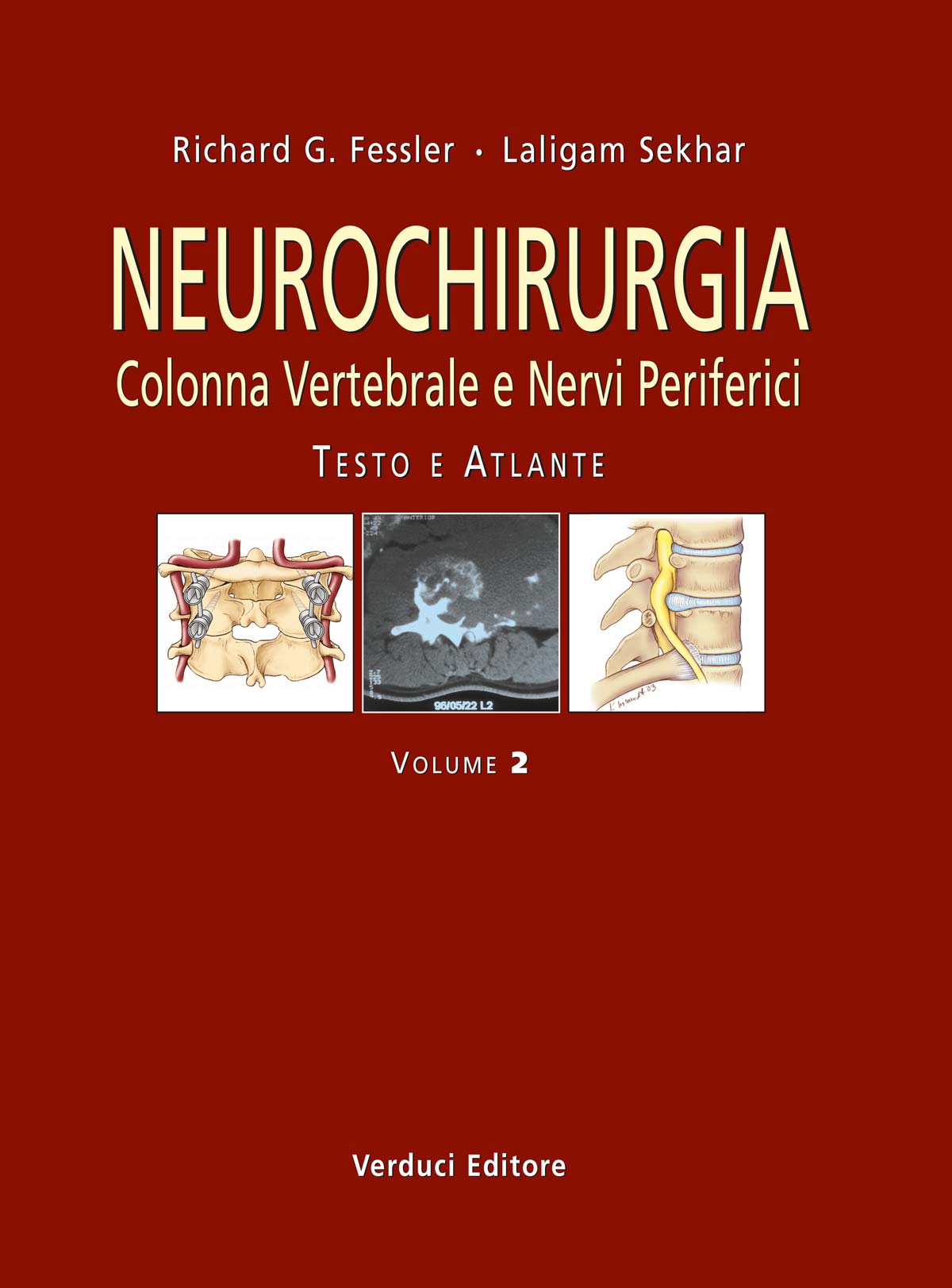
Neurochirurgia – Colonna Vertebrale e Nervi Periferici
Two-volume large-format work (22 x 28), 1,200 pages, 1,269 illustrations—mostly in colour—and numerous tables. Printed entirely in colour and bound with a full-colour printed, plastic-laminated dust jacket.
This text is a comprehensive, state-of-the-art overview of surgical techniques for the spine and peripheral nerves. This atlas shows all types of surgical approaches (anterior, anterolateral, posterior and posterolateral) used in procedures on peripheral nerves and the spine, both cranial and caudal segments. Each of the seven sections opens with an in-depth discussion of pathology, aetiology and differential diagnosis, explaining the underlying scientific principles of the various disorders and conditions of the spine and peripheral nerves. The technique-based chapters outline the goals of surgery, indications and contraindications, anaesthesiological considerations, positioning, a detailed description of surgical procedures, and advantages and disadvantages; all supported by more than 1,200 high-quality illustrations, largely in colour. It is therefore a complete and highly didactic text, useful for residents as well as for neurosurgeons and orthopaedic surgeons with an interest in spine surgery.
Original price was: €340,00.€323,00Current price is: €323,00.
Additional information
| edizione | 2006 |
|---|---|
| autori | Fessler R.G., Sekhar L. |
| formato | 2 volumi grande formato (22 x 28) |
| pagine | 1.200 pagine |
| informazioni extra | rilegato con sovracoperta stampata a colori e plastificata |
Description
VOLUME 1
Section I: Occipito-cervical junction
- Disorders of the craniovertebral junction
- Abnormalities of the cranio-cervical junction
- Degenerative and rheumatic disorders of the occipito-cervical junction
- Tumours of the occipito-cervical junction
- Trauma of the occipito-cervical junction
- Anterior approach
- Transoral approach to the cranio-cervical junction: general principles
- Transoral odontoidectomy
- Extended transoral procedures and removal of midline intradural tumours
- Reconstruction after a transoral approach
- Extended maxillotomy approach for high cervical pathology
- Anterolateral approach
- Retropharyngeal approach to the occipito-cervical junction
- Reconstruction after a retropharyngeal approach to the occipito-cervical junction
- Posterior approach
- Posterior suboccipital and upper cervical exposure of the occipito-cervical junction
- Suboccipital craniectomy and cervical laminectomy for Chiari malformation
- Posterior occipito-cervical fusion and stabilisation using contoured titanium rods and wires
- Occipito-cervical encephalocele: surgical management
- Posterior atlanto-axial fusion: surgical anatomy and technical options
- C1–C2 fusion according to Brooks
- Posterolateral approach
- Extreme lateral transcondylar transtuberclar approach to the anterior cranio-cervical junction
Section II: Mid-cervical spine
- Disorders of the mid-cervical spine
- Congenital bony abnormalities of the mid and lower cervical spine
- Degenerative diseases of the cervical spine and cervical stenosis
- Intramedullary tumours of the mid and lower cervical spine and spinal cord
- Trauma of the mid and lower cervical spine
- Anterior approach
- Cervical spine: anterior approach
- An anterior approach for microforaminotomy (transuncal) to the cervical spine
- Odontoid screw placement
- Posterior approach
- Posterior approach to the cervical spine
- Cervical laminectomy
- Cervical laminoplasty
- Posterior cervical foraminotomy
- Posterior cervical discectomy
- Posterior stabilisation using Bohlman’s triple-wire technique
- Posterior stabilisation using the titanium rectangle technique
- Posterior exposure and release of locked vertebral facet joints
- Posterior stabilisation via the lateral masses
- Posterior cervical stabilisation using interfacet wires
- Posterior subaxial cervical stabilisation using sublaminar cables
- Surgical treatment of intramedullary spinal tumours
- Posterior approach for removal of intradural extramedullary tumours
Section III: Cervico-thoracic junction
- Disorders of the cervico-thoracic junction
- Tumours of the cervico-thoracic junction
- Anterior approach
- Supraclavicular approach to the cervico-thoracic junction
- Transsternal approach to the cervico-thoracic junction
- Transclavicular–transmanubrial sternal approach to the cervico-thoracic junction
- Vertebrectomy following anterior approaches
- Anterior reconstruction after decompression through anterior approaches
- Anterolateral approach
- Anterolateral transthoracic approach
- Posterolateral approach
- Extrapleural parascapular lateral exposure of the upper thoracic spine
Section IV: Thoracic and thoracolumbar spine
- Disorders of the thoracic and thoracolumbar spine
- Congenital abnormalities of the thoracic and thoracolumbar spine
- Disc disease of the thoracic and thoracolumbar spine
- Tumours of the thoracolumbar spine
- Trauma of the thoracic and thoracolumbar spine
- Anterior/anterolateral approach
- Lateral transthoracic approach to the spine
- Thoracoabdominal approach and reconstruction
- Retroperitoneal approach and reconstruction
- Transthoracic sympathectomy
- Transthoracic discectomy
- Transthoracic vertebrectomy
- Anterolateral reconstruction with plate and graft
- Posterolateral approach
- Costotransversectomy
- Posterior approach
- Thoracic laminectomy
- Thoracic laminoplasty
- Thoracic epidural abscess
- Thoracic extension osteotomy
- Diagnosis, therapeutic management and transpedicular decompression of thoracic disc herniation
- Spinal arteriovenous malformations
- Resection of intradural extramedullary tumours of the thoracic spine
- Open anterolateral cordotomy
- Commissural myelotomy
- Dorsal root entry zone (“DREZ operation”)
- “DREZ operation” of the caudal nucleus
- Syringopleural shunt
- Syringosubarachnoid shunt
- Syringoperitoneal shunt
- Posterior approach and in situ arthrodesis of the thoracic spine
- Thoracic spine pedicle screw instrumentation
VOLUME 2
Section V: Lumbar and lumbosacral spine
- Disorders of the lumbosacral spine
- Spondylolisthesis in childhood
- Degenerative lumbar disc disease
- Tumours of the lumbar and lumbosacral spine
- Trauma of the lumbar spine
- Anterior approach
- Computer-assisted lumbosacral fusion
- Anterior transperitoneal approach to the lumbosacral junction
- Anterolateral approach
- Anterolateral retroperitoneal approach to the lumbosacral spine
- Posterior approach
- Approach to the lumbar spine
- Lumbar laminectomy
- Hemilaminectomy
- Foraminotomy
- Microdiscectomy
- Extreme lateral microdiscectomy
- Repair of cerebrospinal fluid fistulas
- Lumboperitoneal shunt
- Rhizotomy of lumbosacral nerve roots
- Resection of cauda equina ependymomas
- Release of tethered spinal cord
- Resection of lumbosacral lipomas
- Transverse process arthrodesis
- Posterior lumbar interbody fusion and stabilisation with transpedicular screws
- Posterior fusion with rod-and-hook stabilisation
- Posterior fusion with Luque instrumentation
- Implantation of morphine or baclofen pumps
- Repair of myelomeningocele
- Resection of congenital spinal dermal sinus/dermoid
- Resection of sacrococcygeal teratoma
- Surgical treatment of spinal dysraphism
- Repair of diastematomyelia
- Sacral agenesis
- Selective dorsal rhizotomy of the lumbosacral spinal cord for spasticity in cerebral palsy
- Iliac crest bone grafting
Section VI: Minimally invasive spine procedures
- Cervical spine
- Endoscopic cervical foraminotomy
- Thoracic spine
- Endoscopic thoracic sympathectomy
- Thoracoscopically assisted spinal surgery
- Lumbar spine
- Lumbar chemonucleolysis
- Arthroscopic and endoscopic microdiscectomy via paramedian posterolateral access
- Endoscopic epidural foraminal discectomy
- Percutaneous spinal cord stimulator implantation
- Retroperitoneal exposure of the lumbar spine
- Microendoscopic discectomy
- Microendoscopic decompression for lumbar stenosis
- Transforaminal lumbar interbody fusion with microendoscopic assistance
- Vertebroplasty and kyphoplasty
Section VII: Peripheral nerves
- Brachial plexus disorders
- Peripheral nerve neoplasms
- Assessment and treatment of traumatic peripheral nerve injuries
- Compressive peripheral nerve lesions
- Brachial plexus surgery
- Supraclavicular approach to the brachial plexus
- Infraclavicular approach to the brachial plexus
- Approach to the spinal accessory nerve
- Approach to the axillary nerve
- Musculocutaneous nerve
- Median nerve
- Radial nerve and ulnar nerve
- Lumbosacral plexus disorders
- Lumbosacral plexus trauma
- Tumours of the lumbosacral plexus
- Lumbosacral plexus surgery
- Approach to lower-limb nerves
- Sural nerve
- Other nerves
- Intercostal nerve
- Surgical treatment of ilioinguinal neuralgia
- Surgical treatment of genitofemoral neuralgia
- Lateral femoral cutaneous nerve
- Nerve grafting and reconstruction techniques
Related products
-
 Connolly J.F.
Fratture e Lussazioni
Original price was: €220,00.€95,00Current price is: €95,00. Buy now -
 Frontera W.R. - Silver J.K.
Fondamenti di Medicina Fisica e Riabilitativa
Original price was: €95,00.€55,00Current price is: €55,00. Buy now -
Cosnard G. - Lecouvet F.
Imaging e Clinica del Rachide, delle Meningi e del Midollo
Original price was: €90,00.€85,50Current price is: €85,50. Buy now